DNK International
 By Our Reporter,Kisii.
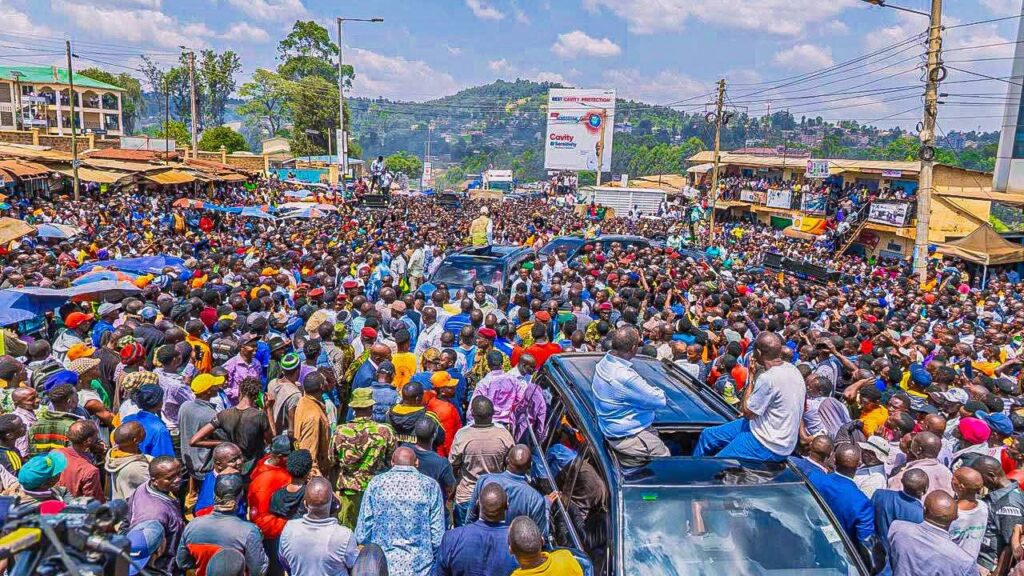
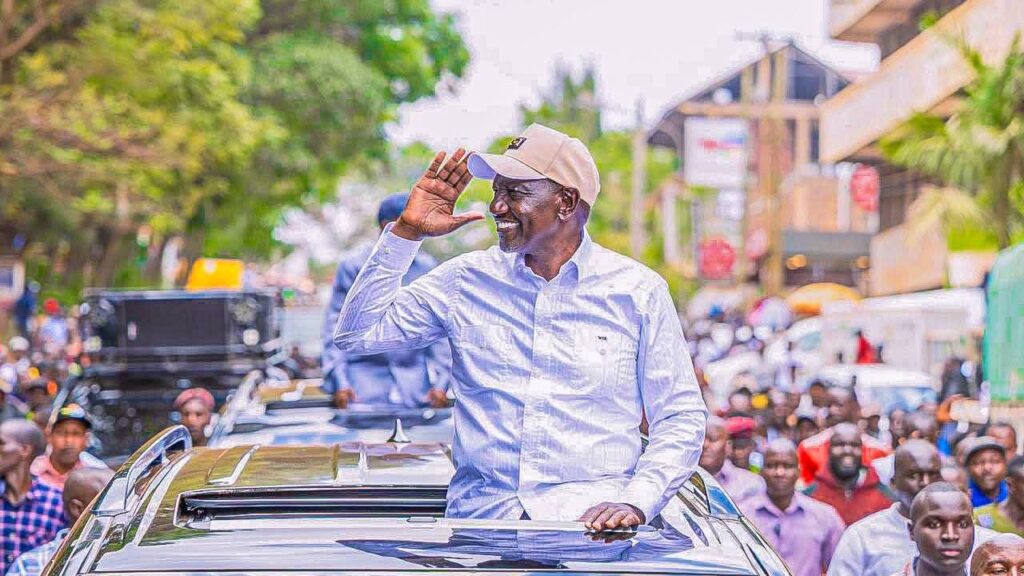
President William Ruto’s grand appearance at Gusii Stadium on January 29, 2026, for the launch of the National Youth Opportunities Towards Advancement (NYOTA) programme was more than a routine government function.
It was a carefully choreographed political statement aimed at a region that has historically remained sceptical of his leadership.
Long regarded as an opposition stronghold, the Gusii region is steadily becoming central to Ruto’s re-election calculus.
The strategy unfolding on the ground reveals a deliberate attempt to convert development into political capital.
During the tour, the President sent a clear signal that Kisii is no longer peripheral to national development planning.
The NYOTA programme anchored on youth empowerment, economic inclusion, and enterprise fits neatly within the broader Bottom-Up Economic Transformation Agenda (BETA).
It also provided Ruto with a familiar rallying cry, “Kuza, imarisha, endeleza vijana!”,a slogan designed to resonate with the region’s largest voting bloc: Gen Z.
The promises unveiled during the visit underscored the President’s intent to embed himself into the everyday economic life of Kisii residents.
The allocation of Sh770 million for a new Gusii Stadium is not merely about sports infrastructure; it is about permanence, visibility, and proof of delivery.
Notably, Ruto went further to spell out timelines.
“By December 2026, Gusii will have an international stadium, and you will celebrate Jamhuri holidays in a well constructed ground,” he declared.
Whether this ambitious promise will be honoured remains a defining question in a region where political loyalty is often shaped by what is visible and tangible.
Housing forms another key pillar of Ruto’s Kisii strategy.
He announced plans to construct 10,000 affordable housing units in Kisii town, including the controversial proposal to relocate the prison to free up land.
Framed as an urban renewal agenda, the plan targets youth, professionals and low income earners struggling with congestion and housing shortages.
By linking the housing project to the creation of 3,000 jobs, the President is aligning development with livelihoods,an approach likely to resonate in a county grappling with unemployment.
In political terms, it is also a calculated attempt to harvest votes by tying policy outcomes directly to household incomes.
As the 2027 general election approaches, Kisii is clearly shaping up as a battleground where development promises will be tested against long standing political allegiances.
The uncertainty remains: will this strategy translate into votes? While Governor Simba Arati has thrown his weight behind Ruto, the President still faces an uphill task in a region that has historically supported the Orange Democratic Movement (ODM).
Yet one thing is evident,Ruto is no longer asking the Gusii region to believe in promises alone.
He is placing concrete, steel, and budgets on the table, betting that visible change can rewrite Kisii’s political story.
The proposed renovation of Suneka Airstrip, estimated at Sh400 million, adds another strategic layer to this recalibration.
The project has a long and politically sensitive history.
Former presidents Mwai Kibaki and Uhuru Kenyatta both promised its upgrade. Uhuru’s administration funded the first phase in 2015, allocating Sh15 million for a perimeter wall, lounge, and parking facilities under the 2014/15 budget.
Phase one reached 85 per cent completion by 2021 before the facility was handed over to the Kenya Airports Authority.
Despite repeated pledges, full commercial upgrades remain stalled as of early 2026.
Beyond connectivity, completing the airstrip would signal Kisii’s integration into regional and national economic networks.
Whether Ruto will finish it “once and for all” remains to be seen.
Targeting women and youth who dominate Kisii’s informal commerce, the President also announced plans to construct 20 modern markets across the county.
A Sh350 million allocation was specifically earmarked for Nyambera Market,once a dumpsite riddled with waste.
“We want mama mbogas and youths to have decent markets where they can transact their business comfortably and safely,” Ruto said.
Further, the President pledged Sh7 billion for road construction covering 270 kilometres and eight new routes to support farmers who form the backbone of Kisii’s rural economy.
Improved roads, he argued, would lower transport costs and stimulate economic activity.
Additional promises included the construction of 7,800 bed capacity student hostels and the resumption of the stalled Kisii Cancer Centre project.
By reviving these initiatives, Ruto is attempting to counter the narrative of unfulfilled promises that has historically fuelled opposition politics in the region.
What makes Ruto’s Gusii strategy particularly notable is its multi-sectoral spread.
Rather than relying on a single flagship project, his administration is rolling out an interlinked web of housing, markets, roads, education, health, and youth programmes.
The aim is to create a sense of sustained engagement rather than episodic political visits.
Whether this development heavy approach will finally shift Kisii’s political loyalty remains uncertain.
But one reality is clear: Kisii is no longer a political after thought in State House calculations.
[DNK-International@February 3, 2026]