DNK International
By Our Reporter,Nairobi
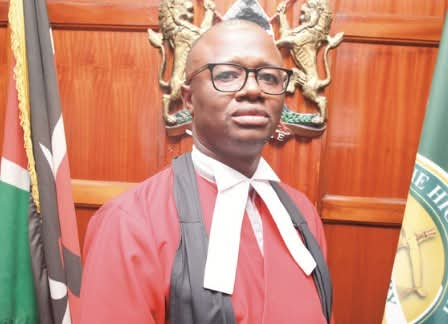
Justice Andrew Bahati Mwamuye has emerged as a prominent figure in Kenya’s constitutional judiciary after delivering a judgment that declared unconstitutional a law restricting retired presidents from holding political party office beyond six months after leaving State House.
Mwamuye, a High Court judge appointed to the Judiciary in 2024, delivered the judgment at the High Court in Kiambu on Monday in a Constitutional and Human Rights Petition E037 of 2026.

The case was filed by Sheria Mtaani and a leading lawyer Shadrack Wambui against the Senate, National Assembly, Attorney General and other respondents.
At the centre of the dispute was Section 6 of the Presidential Retirement Benefits Act, which barred a retired president from holding office in a political party for more than six months after leaving the presidency.
Mwamuye declared the provision unconstitutional, null and void.
The judge also struck down Sections 4(1), 4(2) and 4(3) of the Act, which allowed Parliament, under specified circumstances, to withhold, reduce or withdraw retirement benefits payable to a former president.
Section 4(4), concerning benefits payable to surviving spouses, was left intact because it had not been challenged.
Mwamuye’s reasoning was anchored on the Constitution’s protection of political participation and retirement benefits.

Article 38 guarantees citizens political rights, while Article 151(3) provides constitutional protection for retirement benefits payable to a former president and former deputy president.
The judge reasoned that leaving the presidency ends the office and its executive authority but does not terminate an individual’s citizenship or constitutional rights.
In one of the memorable observations in the judgment, he stated: “A retired President remains a citizen. Retirement from office ends the office; it does not end the person.”
He further observed: “Influence is not office. Influence is not executive authority. Influence is not a constitutional disability.”
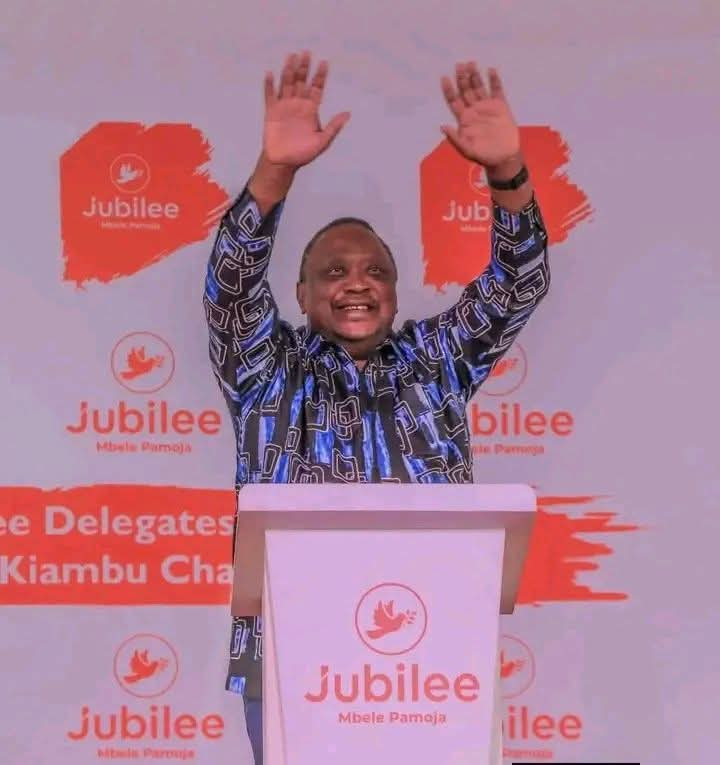
The judgment has particular significance for former President Uhuru Kenyatta. It came shortly after Justice Lawrence Mugambi had upheld Section 6 of the Act, finding that a retired president could not continue holding formal political party leadership beyond six months after retirement, although the former president could remain a party member and participate in other political activities.
Following Justice Mugambi’s recent ruling, Uhuru indicated that he would facilitate the handover of the Jubilee Party chairmanship.
His office, however, maintained that the decision did not prevent him from participating in Kenya’s political life.
Justice Mwamuye’s subsequent decision invalidating Section 6 changes the legal position at the High Court level and removes the statutory six-month restriction that had been relied upon in the earlier ruling.
The two judgments therefore represent competing High Court interpretations of the same statutory restriction.
Any further legal effect will depend on the appellate process and how the Judiciary ultimately resolves the conflicting positions.
A look at Mwamuye’s professional journey is rooted in taxation, commercial law, environmental law and constitutional litigation.
According to the official Judiciary profile seen by Daily News Kenya-International, he studied for a Bachelor of Laws degree at the University of Manchester in the United Kingdom, graduating in 2005.
He later obtained a Postgraduate Diploma in Law from the Kenya School of Law in 2007 and was admitted to the Roll of Advocates in 2008.
His career before joining the bench was largely in private practice and public service.
Between 2007 and 2011, he worked at the Kenya Revenue Authority, initially as a Revenue Officer and later as a Legal Officer.
He then joined Iseme, Kamau and Maema Advocates as a Senior Tax Associate from 2012 to 2013.
From 2013 to 2018, he was a partner at Mwamuye, Kimathi and Kimani Advocates before becoming Managing Partner of Bahati Mwamuye and Associates, a position he held from 2018 until his appointment to the High Court in 2024.
He also served as a member of the National Environment Tribunal from 2016 to 2023.
His experience at the National Environment Tribunal gave him exposure to disputes involving environmental regulation, development projects and administrative decision making before he moved fully into judicial service.
Since becoming a High Court judge, Mwamuye has handled cases touching on constitutional rights, criminal justice, privacy, public administration and other areas of law.
Among the notable matters associated with him is Arunda v Office of the Data Protection Commissioner & another, decided in August 2025, in which he upheld the constitutional validity of the framework establishing the Office of the Data Protection Commissioner and dismissed the petition challenging aspects of the Data Protection Act.
In another 2025 criminal appeal, Kinyua v Republic, Mwamuye allowed an appeal against a death sentence and substituted it with a 30year prison term on two counts, directing that the sentence run concurrently and be calculated in accordance with Section 333(2) of the Criminal Procedure Code from the date the appellant was first held in custody.
He also presided over litigation concerning adolescent sexual conduct and the application of the Sexual Offences Act.
In a 2026 decision, the court addressed the constitutional implications of applying criminal law to consensual sexual conduct between adolescents, with the judgment attracting considerable legal and public debate over children’s rights, dignity and the protection of minors.
In December 2025, Mwamuye also issued conservatory orders temporarily suspending implementation of the Kenya-US Health Cooperation Framework while a case concerning data privacy and the handling of Kenyan health information was considered.
The matter attracted international attention because of the scale of the health agreement.
His record at the High Court has also included ordinary criminal and constitutional matters.
At the Kiambu High Court, for example, he handled Wanjiru v Republic in May 2026, where he ordered that time spent in custody before sentencing be taken into account under Section 333(2) of the Criminal Procedure Code.
Mwamuye has also shown a willingness to insist on procedural certainty in politically sensitive litigation.
In June 2026, while handling proceedings concerning a proposed Senate debate on former President Uhuru Kenyatta’s retirement benefits, he questioned an application based on a matter that had not yet appeared on the Senate Order Paper.
“We may spend 60 days doing an application that may not proceed,” he observed, according to reports of the proceedings.
His Monday ruling is therefore the latest and arguably most politically consequential chapter in a judicial career that began outside the Judiciary and has passed through taxation, private legal practice, environmental adjudication and constitutional litigation.

The Monday judgment has placed Justice Mwamuye at the centre of an important constitutional debate: whether a person who once occupied Kenya’s highest elective office should, after leaving State House, continue to enjoy the same political rights as any other citizen or be subject to special statutory restrictions because of the influence associated with the former office.
For retired presidents such as Uhuru Kenyatta, the immediate significance of Mwamuye’s ruling is that Section 6 can no longer, following this judgment, be relied upon to bar them from holding political party office after six months of retirement.
The ruling also invalidated provisions that could have been used to reduce or withdraw protected retirement benefits.
It does not, however, automatically determine every question surrounding a former president’s political activities, nor does it eliminate the possibility of an appeal or a different determination by a higher court.
Justice Bahati Mwamuye’s journey from a tax lawyer and environmental tribunal member to the High Court Bench, and now to the centre of a major constitutional dispute involving Kenya’s former presidents, illustrates the increasingly significant role of constitutional litigation in determining the boundaries between public office, retirement and the continuing rights of individual citizens.
Want to be featured, or know a personality who deserves recognition?
📞 WhatsApp: +254 703 633820 / +254 754 168624
✉️ Email: dailynewskenya0@gmail.com
SUPPORT CITIZEN JOURNALISM
Help us keep independent, community-focused journalism alive.
Paybill: 222111
Account No.: 3179512
Your support helps us report, inform and amplify stories from communities that matter.
Thank you for supporting citizen journalism.
🗓️ [Daily News Kenya-International@September 22, 2026]